Convocatoria: número 39, julio-octubre 2027
Since the mid-twentieth century, various homosexual liberation and sexual dissidence movements began to organize across different contexts with the aim of transforming the living conditions of those who challenged prevailing sexual and gender norms. At the same time, travesti, vestida, and trans movements emerged with their own trajectories and demands, contributing to the formation of contemporary trans movements and other forms of sex-gender dissidence. These experiences not only gave rise to new forms of political organization and intervention in the public sphere, but also produced forms of knowledge, memories, and collective practices that challenged hegemonic understandings of the body, gender, sexuality, and communal life. This entailed both a renewal of and a confrontation with multiple forms of pedagogy shaped by familialism, heteronormativity, and sexism.
The works of Michel Foucault on the panopticon and apparatuses of power; Guy Hocquenghem’s critique of sex education in schools; Melanie Klein’s work on child development and the constitution of subjectivity; and Monique Wittig’s and Shulamith Firestone’s critiques of anthropology and psychoanalysis laid the groundwork for examining the relationships among education, sexuality, and power. In Latin America, Carlos Monsiváis’s contributions on the media, Gloria Anzaldúa’s work on Chicana education, and, more recently, the work of Val Flores and Facundo Saxe on dissident pedagogies, methodologies, and curricula provide analytical tools for examining the effects of education at the intersections of sexuality, race, class, and gender, both within formal and non-formal education and across multiple institutions.
Drawing on this body of diverse knowledge, which points not only to a single institution but to the full range of possible pedagogical apparatuses, it is also necessary to ask how sexuality is traversed by other characteristics that enhance or constrain the self-agentic capacity of subjectivities to constitute themselves in relation to others. Finally, we believe that educational experiences created by and for communities themselves, as well as proposals for travesti, trans, and non-binary pedagogies, acquire particular relevance.
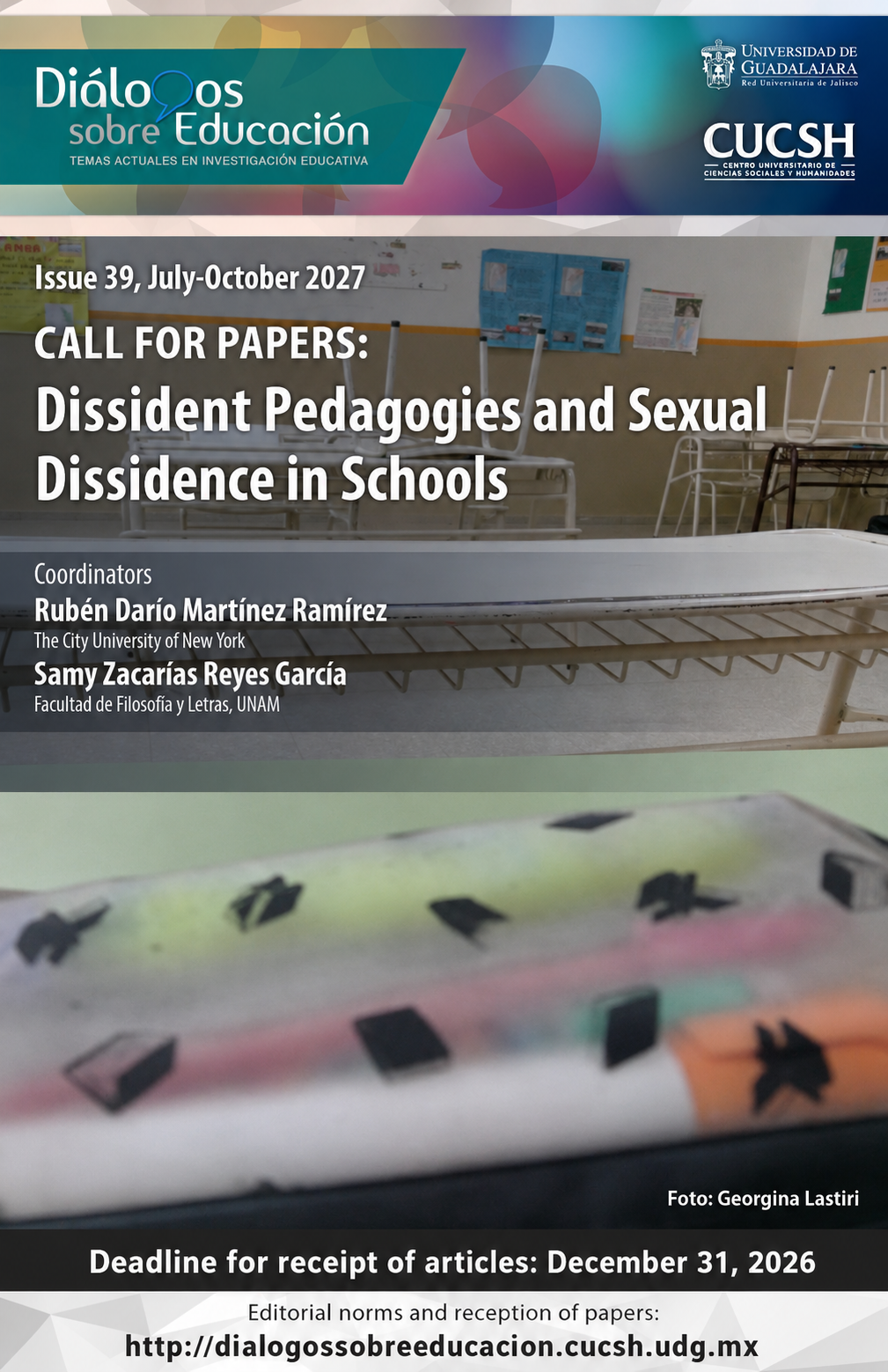
Building on these discussions, issue 39 of Diálogos sobre Educación. Temas actuales en investigación educativa proposes the dossier “Dissident Pedagogies and Sexual Dissidence in Education,” devoted to exploring the multiple ways in which sexual and gender dissidences have challenged, transformed, and produced educational practices. We seek to broaden the discussion beyond a restricted conception of queer/cuir pedagogy by incorporating experiences and forms of knowledge produced by gay, lesbian, marica, lencha, travesti, trans, and non-binary people and communities, as well as other forms of sex-gender dissidence.
We ask: In what ways can a dissident pedagogy be made possible? How can the hegemonic forms and heterocisnormative perspectives that permeate formal and non-formal education be decentered? What forms of knowledge, bodies, and experiences are excluded from educational spaces, and what strategies can be used to contest these exclusions?
People and communities belonging to sexual dissidences continue to face various forms of violence, exclusion, and restrictions on their rights, including the right to a dignified, safe, and discrimination-free education. In response, this dossier seeks to bring together research, theoretical reflections, and experiences that enable us to conceive of education not only as a space in which social norms are reproduced, but also as a terrain of contestation, resistance, and the production of alternative forms of life.
In this regard, we invite contributions addressing, among others, the following thematic areas:
- Queer, cuir, and dissident pedagogies.
- Travesti, trans, and non-binary pedagogies.
- Education, heteronormativity, and cisnormativity.
- Educational experiences of LGBT+ people and communities.
- Teaching practices and anti-normative pedagogies.
- Community-based knowledge and non-institutional pedagogies of sexual dissidence.
- Experiences in upper-secondary schools and self-managed educational spaces.
- Feminist, anti-racist, and decolonial pedagogies in dialogue with queer/cuir pedagogies.
Note: Until further notice, submissions to the Other Articles section will not be accepted. Thank you for your understanding.